
Most business owners know the value of their home, investment accounts, and retirement savings. But few know the true value of their business, or more importantly, what drives that value. That can become a costly mistake when it comes time to exit.
For many owners, their business represents the largest asset on their personal balance sheet. Yet too often, planning for exit begins only when a sale opportunity appears or burnout sets in. By then, owners may discover a troubling reality: the business is not worth what they expected, and the proceeds from a sale may not fully fund the lifestyle they envision for retirement.
This is where understanding intangible capital becomes critical. The Exit Planning Institute (EPI) refers to these value drivers as the “4Cs” of intangible capital: Human Capital, Customer Capital, Structural Capital, and Social Capital.1 Together, these factors often account for the majority of a company’s transferable value, up to roughly 80%2 which is far beyond the numbers found on a profit-and-loss statement.
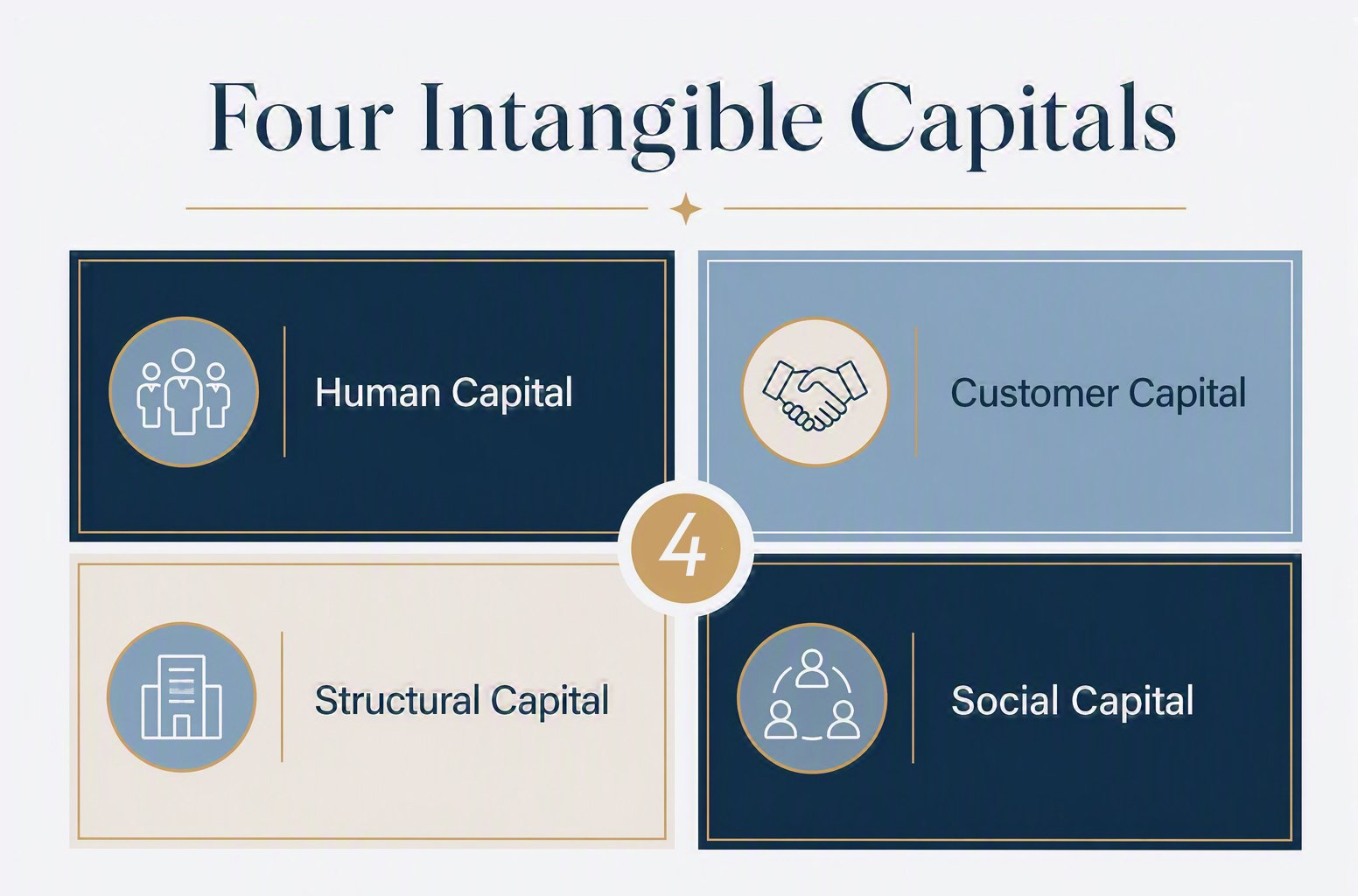
Human Capital
Human Capital reflects the strength of the leadership team and employees. Businesses that rely heavily on the owner for relationships, decision-making, or operations often receive lower valuations because buyers perceive greater risk.
A company with strong management depth and accountability becomes far more transferable—and therefore more valuable.
Customer Capital
Customer Capital measures the durability and diversity of customer relationships. Recurring revenue, long-term contracts, and a broad client base reduce uncertainty for buyers.
On the other hand, revenue concentration among a few customers can negatively impact valuation multiples.
Structural Capital
Structural Capital includes systems, processes, technology, and operational infrastructure. A business with documented procedures and scalable operations is easier to transition and operate post-sale.
Buyers pay premiums for businesses that can function efficiently without constant owner involvement.
Social Capital
Social Capital encompasses company culture, trust, brand reputation, and internal alignment. While difficult to quantify, culture often determines whether the other three capitals perform at a high level.
Strong social capital can improve employee retention, customer loyalty, and long-term stability.
Together, these intangible capitals directly influence how buyers evaluate risk, growth potential, and sustainability, all of which impact valuation.
Looking Beyond Today’s Valuation
Exit planning conversations should extend beyond simply determining what a business is worth today. The more important question is whether the business value aligns with the owner’s long-term personal goals.
In our last article, we discussed two concepts, the Value Gap and the Wealth Gap, that help owners evaluate this alignment. If a gap exists, understanding the 4Cs can help to close it.
Improving these intangible capitals can increase enterprise value, strengthen buyer confidence, and improve deal structure opportunities. Just as importantly, it gives owners clarity. They can make informed decisions years before a transition rather than reacting under pressure.
Ultimately, exit planning is not simply about completing a transaction. It is about creating a business capable of supporting financial independence after the sale is complete.
Take our Exit Readiness Checkup for Business Owners, designed to help you evaluate where you stand and provide insights into how coordinated and prepared your current strategy is.