
This time of year, most of our conversations are about wrapping up the current tax year. But there’s something new coming in 2027 that’s worth planning for. Starting January 1, you’ll be able to give up to $1,700 to help a child get an education that fits them and get that money back, dollar for dollar, when you file your federal return. If you’re married and file jointly, a couple can give up to $3,400.
It’s called the Education Freedom Tax Credit. Congress created it in last year’s tax law, and on October 1, 2026, the Treasury Department and IRS released the proposed rules that spell out how it will work.
How the credit works
The idea is simple. You make a cash gift to an approved Scholarship Granting Organization (SGO), a charity that awards K-12 scholarships, and then claim a federal tax credit for the same amount. That’s different from a typical charitable deduction. A deduction lowers the income you’re taxed on, so it only saves you a percentage of the gift. A credit comes straight off your tax bill.
- Up to $1,700 per person, or $3,400 for a married couple, every year.
- It’s non-refundable. The credit can bring your federal tax down to zero, but it won’t create a refund on its own.
- Unused credit carries forward for up to five years.
- You don’t have to give in your own state. Approved organizations in any participating state qualify, wherever you live.
What your gift really costs
A $1,700 scholarship gift comes back in full.
Federal tax you get back on a $1,700 gift: the rest is what the gift really costs you.
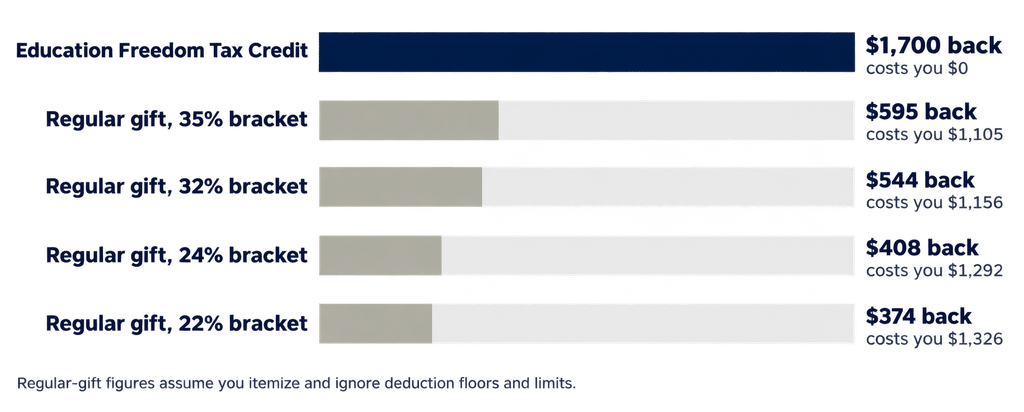
With an ordinary charitable gift, what you save depends on your tax bracket and whether you itemize. Even in the 35% bracket, a $1,700 gift saves you about $595. With this credit, the full $1,700 comes back to you, so the gift effectively costs you nothing.
Where your gift goes
Your gift turns into a scholarship for a real child. That might mean a reading tutor for a third grader who’s falling behind, specialized services for a teenager with a learning difference, or tuition at a school that suits a child better than the one their ZIP code assigned. Scholarships can pay for tuition, tutoring, special-needs services, books, supplies, and computers, and Treasury estimates about 96% of children in participating states will be eligible.
The bigger picture
States that have opted in for 2027:
30 of 50 states, as of the IRS list dated September 14, 2026.
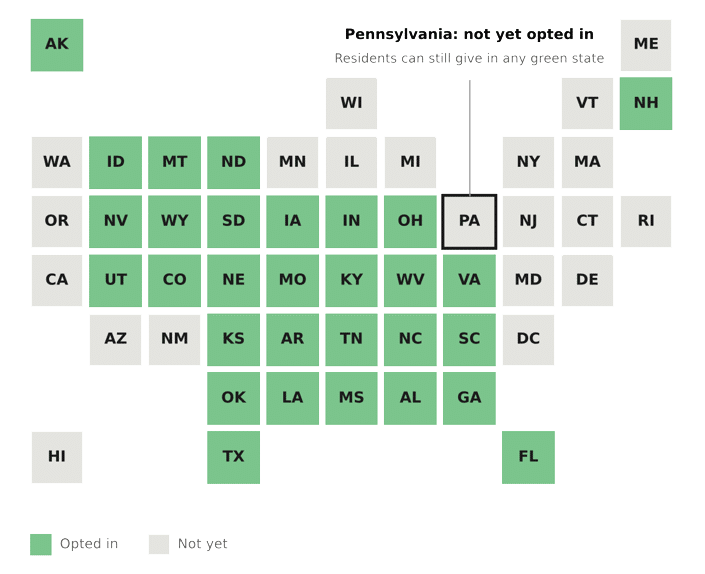
So far, 30 states have opted in, and more could join before the deadline. Treasury expects that by 2030, more than 11 million taxpayers will give close to $26 billion a year, enough to fund as many as 2.2 million scholarships.
Before you give: five things to know
- Pennsylvania hasn’t opted in yet, but that doesn’t shut you out. You can still give to approved organizations in participating states and claim the full credit.
- Stick to the official IRS list. Only gifts to approved Scholarship Granting Organizations qualify, and the IRS list is the simplest way to confirm one.
- Each spouse needs to give. A married couple reaches $3,400 only if each spouse gives $1,700 of their own. A single $3,400 gift from one spouse only earns $1,700, so plan on two gifts, one in each name.
- No double dipping. The portion you claim as a credit can’t also be taken as a charitable deduction.
- You need a federal tax bill to benefit. The credit only offsets tax you actually owe, though the five-year carryforward gives you some breathing room.
Keep in mind these rules are still proposed, so details could change. We’ll keep you informed as final guidance comes out.
How we can help
The credit starts on January 1, 2027. We’re still waiting on a few details but now is a good time to consider where it fits in your 2027 giving. If you’d like to talk it through, reach out to your wealth advisor. We’re always happy to help.
Sources:
1. IRS news release IR-2026-117 (Oct. 1, 2026)
2. IRS: Federal Scholarship Tax Credit, participating states for 2027
For general education only, not individualized tax advice. Please talk with your tax professional and financial advisor before acting.